How to Install a 17x17x4 Air Filter the Right Way
By Jenna Eidson · Published November 5, 2026 · Updated November 5, 2026
TL;DR
Installing a 17x17x4 air filter takes about two minutes: turn the system off, point the airflow arrow toward the blower, slide the filter fully into the media cabinet's tracks, and close the door without forcing it. Most fit problems come from depth, not face size, so match the filter to the depth your cabinet was built for.
For this guide, we compared 17x17x4 specs on four retailer listings, worked out the gap math for this frame, and used the cabinet door as a fit test.
Key Takeaways
The airflow arrow always points toward the blower and away from the return duct.
"4-inch" is a nominal size. A typical 17x17x4 pleated filter is about 3⅝ inches deep, while some brand-specific cartridges run about 4⅜ inches.
A door that won't close means the filter is too deep, not fully seated, or crooked. Never force the door or trim the filter.
Check monthly and replace about every 90 days.
What Size Is a 17x17x4 Air Filter?
A 17x17x4 air filter is a pleated HVAC filter with a 17 x 17 inch face and a nominal 4-inch depth. Its real depth is usually under 4 inches, and that gap between label and filter causes most cabinet fit problems.
Filterbuy is a U.S. air filter manufacturer based in Talladega, Alabama, that makes and sells HVAC and furnace filters online in more than 600 sizes. Its 17x17x4 pleated filter is made in the USA, comes in MERV 8, 11 and 13, and actually measures 17 x 17 x 3.63 inches, according to Filterbuy's 17x17x4 air filter listing.
That depth suits many standard 4-inch cabinets, but not all. Some brand-specific cartridges, such as Honeywell's, run about 4⅜ inches deep. Before you order, compare the label inside the cabinet door with the size printed on your old filter.
Which Way Does a 17x17x4 Filter Go?
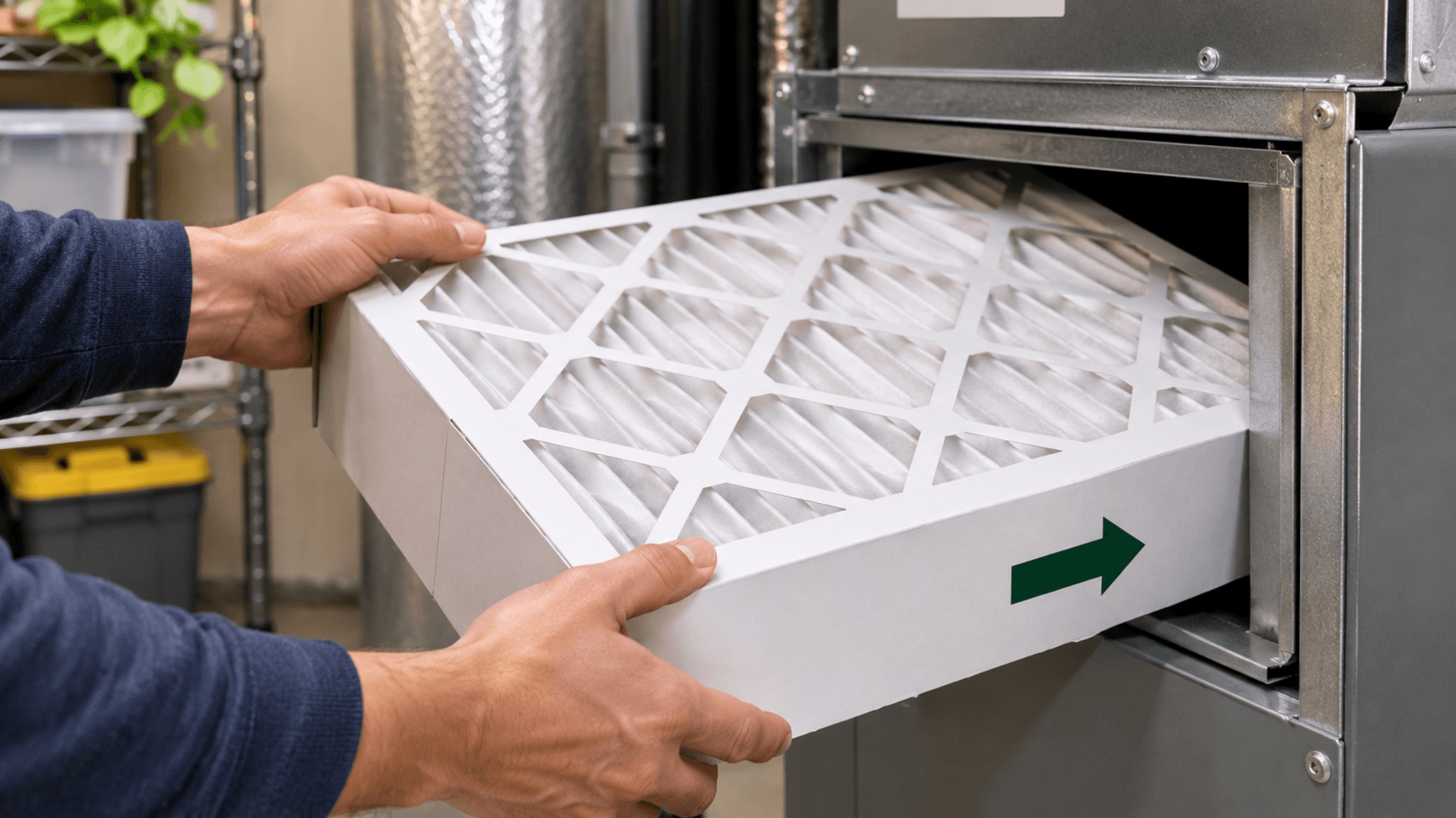
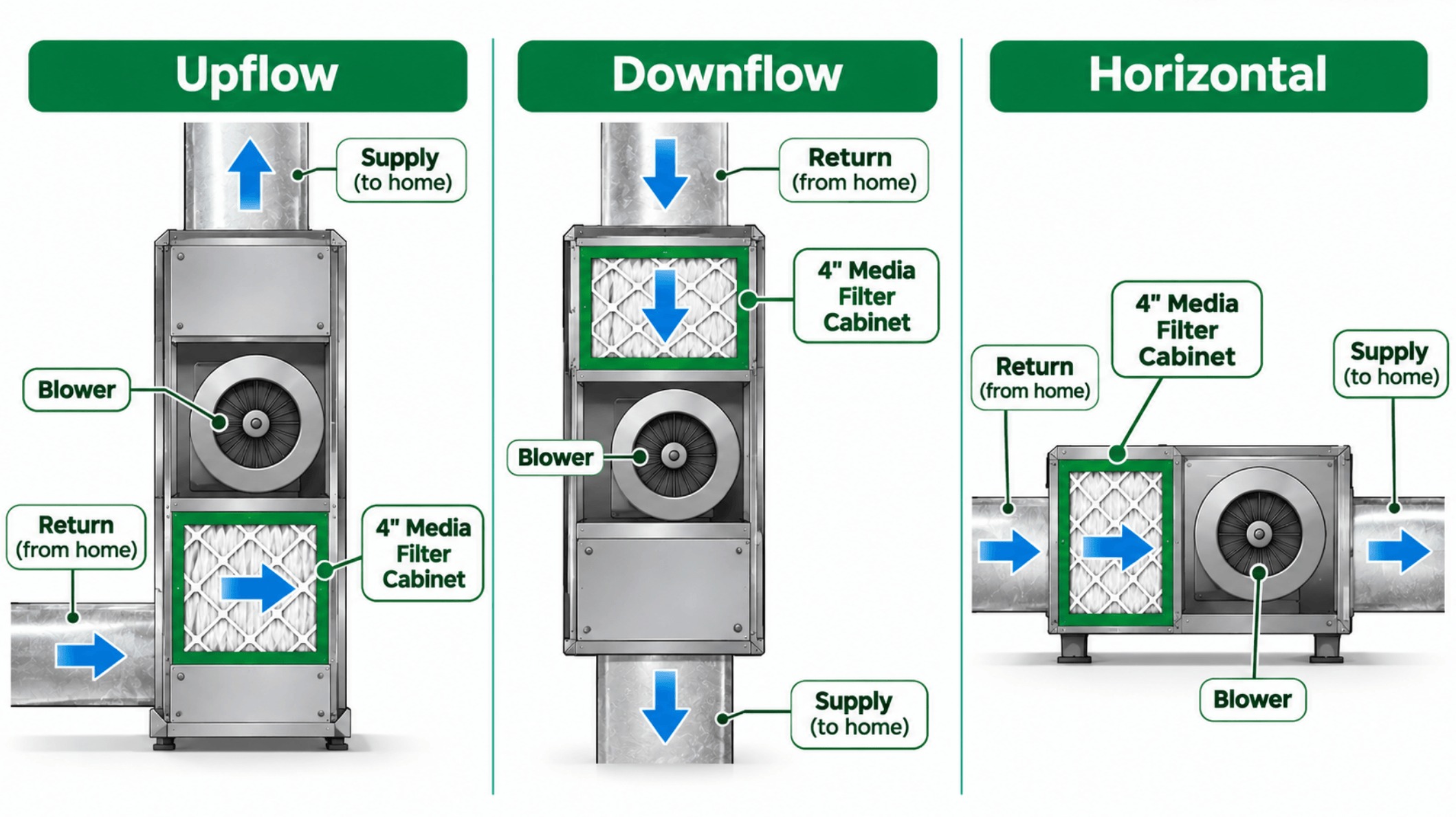
A 17x17x4 filter's airflow direction is printed as an arrow on its frame. It points away from the return duct and toward the blower: up in an upflow furnace, down in a downflow furnace, and toward the air handler in a horizontal unit.
No arrow on the old filter? The dirty side faced the incoming air.
How Do You Install a 17x17x4 Air Filter?
Turn the system off at the thermostat. A running blower pulls the filter against the rails.
Check the new filter. Confirm the actual size and find the airflow arrow.
Open the cabinet door. Set it down flat so its gasket doesn't bend.
Slide the old filter out slowly. A gray dust line along one edge marks where air leaked around it.
Clean the tracks. Vacuum or wipe the rails so nothing stops the new filter short.
Slide the new filter in, arrow toward the blower. Push it to the back of the cabinet, square rather than tilted.
Close the door with light pressure. If it needs a hard push, check the fit (see the next section).
Date the frame and restart. Run your hand along the door seam. You shouldn't feel air being drawn in.
Why Won't the Door Close on My 17x17x4 Filter Cabinet?
A door that won't close is a fit warning, not a latch problem. Forcing it bends the frame and breaks the seal.
Filter too deep: a 4⅜-inch or 5-inch cartridge won't fit a cabinet built for 3⅝-inch filters.
Not fully seated: debris or a bent track lip stops the filter early. Clear the track and reinsert it.
Crooked in the tracks: one corner riding up blocks the door. Square the filter and slide it in again.
Wrong face size: a near-match size is not a safe substitute.
A filter that's too shallow lets the door close but leaves the gasket loose. If it wiggles, check its depth.
Small gaps add up. When we ran the numbers, a 1/8-inch gap around the 68-inch perimeter of a 17x17 frame opened about 8.5 square inches of unfiltered path, roughly a playing card. The U.S. EPA advises a snug fit so air can't leak around the filter.
"A sloppy fit lets it sneak right past your filtration entirely." Source: The Filterbuy Air Quality Team
How Can You Tell a 17x17x4 Filter Isn't Sealing?
Look for these signs:
Whistling at the door: air is being pulled through a gap. Check the latch and gasket.
A rattling door or sliding filter: the filter is too shallow for the cabinet.
A gray stripe on one edge of the old filter: air leaked around that edge.
A filter bowing toward the blower: it may be backward, overdue or too restrictive.
Light around the frame (system off): there's an open path. Re-seat the filter or fix the rail.
Is One 17x17x4 Filter Big Enough for Your System?
One 17x17x4 filter fits most systems up to about 2 tons. We calculated face velocity (the speed air hits the filter) using its 2.0-square-foot face and a common design rule of 400 cubic feet per minute (CFM) per ton.
1.5 tons (600 CFM): about 300 feet per minute (FPM).
2 tons (800 CFM): about 400 FPM.
3 tons (1,200 CFM): about 600 FPM.
4 tons (1,600 CFM): about 800 FPM.
If your system is 2.5 tons or larger and this is its only filter, ask an HVAC technician before moving up to MERV 13.
How Often Should You Replace a 4-Inch 17x17 Filter?
Check it monthly and replace it about every 90 days. Filterbuy recommends every two months with pets and every six weeks when someone has asthma or allergies. Change it sooner during wildfire season, too. This guide to live wildfire and smoke maps for Albuquerque, NM shows how to tell when outdoor smoke may load your filter faster.
What Does a 17x17x4 Filter Cost per Year?
At four changes a year, expect roughly $73 to $176, based on prices we checked on November 5, 2026.
One at a time: $43.99 each, about $176 a year.
2-pack: $27.49 each, about $110 a year.
6-pack: $21.16 each, about $85 a year.
12 or more: $18.33 each, about $73 a year.
Buying in bulk is usually the biggest saving.
Essential Resources: 7 Trusted Guides for Choosing and Caring for a 17x17x4 Air Filter
1. Pick a Filter That Fits Snugly and Filters Well
The U.S. EPA's Guide to Air Cleaners in the Home recommends MERV 13 or the highest rating your system can handle, in a filter that fits snugly.
2. Know Exactly What Each MERV Level Captures
The National Air Filtration Association's "Understanding MERV" guide shows the particle sizes each MERV level must remove in lab tests.
3. Get MERV 13 Guidance From the Standard's Source
The ASHRAE Filtration and Disinfection FAQ comes from the engineering society behind the MERV test standard.
4. Match Filtration to the People in Your Home
The American Lung Association's Clean Air at Home page explains who faces the most risk from poor indoor air.
5. Stay on a Simple Filter-Change Schedule
ENERGY STAR's Heat & Cool Efficiently page advises checking the filter monthly and changing it at least every three months.
6. Cut Energy Waste From a Clogged Filter
The U.S. Department of Energy's air conditioner maintenance guide says replacing a clogged filter can cut an air conditioner's energy use by 5 to 15 percent.
7. Know When Your Ducts Actually Need Cleaning
The U.S. EPA's Should You Have the Air Ducts in Your Home Cleaned? lists the conditions that justify duct cleaning.
Supporting Statistics: What U.S. Research Says About 4-Inch Filter Performance
HVAC systems run less than 25% of the time.
Filters clean air only while the system runs, so bypassed air is filtration you never get back.
MERV 13 filters must capture at least 50% of the finest particles.
They must also remove at least 85% of 1 to 3 micron particles and 90% of 3 to 10 micron particles.
Source: National Air Filtration Association, Understanding MERV
Heating and cooling use nearly half of a home's energy.
Sealing ducts can boost efficiency by up to 20%.
Final Thoughts & Opinion: Seal First, Upgrade Second
A 17x17x4 filter only works when air goes through it, not around it.
My take: check the fit before you chase a higher MERV. A sealed MERV 8 beats a MERV 13 with a gap around it, because bypass air skips the media entirely. Use the cabinet door as your fit test.
Next Steps: Your 17x17x4 Action Plan
Confirm your size. Read the filter frame and cabinet label.
Pick your MERV. Aim for MERV 13 if your system can handle it.
Order the right depth. Buy a spare, too.
Install and test. The door should close easily, and the filter shouldn't rock.
Set reminders. Date the frame and check it monthly.
Look for past bypass. Dust on the blower or registers, or a musty smell when the AC runs, can mean it's time for a duct inspection.
More Filter and Duct Care Guides
1-inch filter sizes: 12x30x1 pleated filters, 14x25x1 filters in bulk, 15x25x1 filters, 16x20x1 pleated filters and 18x30x1 filters.
2-inch filter sizes: MERV 13 14x30x2 filters and MERV 11 15x15x2 filters.
Choosing a furnace filter: Top Furnace Filters and top-furnace-filters.net.
Ducts and installation: duct cleaning in Palm Beach Gardens, FL and HVAC installation near you.
Frequently Asked Questions
What Happens if You Install a 17x17x4 Filter Backward?
Its wire support ends up on the wrong side, so it can bow and open gaps as it loads. Flip it so the arrow points toward the blower.
Can You Use a 1-Inch Filter in a 4-Inch Media Cabinet?
No. It leaves about three inches of open space, a wide bypass path. If your system actually uses a 1-inch slot, our guide to 25x25x1 HVAC furnace filters covers how 1-inch filters are rated and installed.
Can a 5-Inch Filter Replace a 17x17x4?
Only if the cabinet was built for 5-inch media. Otherwise the door won't close.
What if My Cabinet Takes a 2-Inch Filter?
Then you need a 2-inch filter. A 17x17x2 MERV 8 filter has the same face size but measures about 1¾ inches deep.
Where Can I Buy a 17x17x4 Air Filter?
Filterbuy sells 17x17x4 filters direct and through retailers including The Home Depot (MERV 8 two-pack), Target (MERV 11 two-pack) and Amazon. Shoppers in Canada can use Filterbuy Canada's 17x17x4 page (in French). Wherever you buy, confirm an actual size of 17 x 17 x 3.63 inches.
Which MERV Rating Should I Use in a 17x17x4 Cabinet?
The EPA recommends MERV 13 or the highest rating your system can handle. Ask a technician before upgrading an older system. If they advise a lower rating, a 17x17x4 MERV 8 filter handles everyday dust, lint and pollen.
Do I Need Duct Cleaning After Fixing a Filter Gap?
Not automatically. The EPA reserves duct cleaning for visible mold, vermin, or debris blowing from supply registers. A sealed filter stops new buildup but won't remove what's there. That takes professional air duct cleaning.
Glossary
Air filter: A device of fibrous or porous material that removes dust, pollen and mold from the air. See this overview of air filter types.
Nominal size: The rounded size on a filter's label, such as 17x17x4.
Actual size: The filter's measured dimensions, often slightly smaller than nominal.
Media filter cabinet: A metal housing between the return duct and furnace that holds a 4- or 5-inch filter.
Filter bypass: Air that travels around a filter through gaps instead of through the media.
MERV: Minimum Efficiency Reporting Value, the ASHRAE 52.2 rating of how well a filter captures particles.
Learn more about HVAC Care from one of our HVAC solutions branches…
Filterbuy HVAC Solutions - Miami FL - Air Conditioning Service
1300 S Miami Ave Apt 4806 Miami FL 33130
(305) 306-5027
https://maps.app.goo.gl/Ci1vrL596LhvXKU79


